
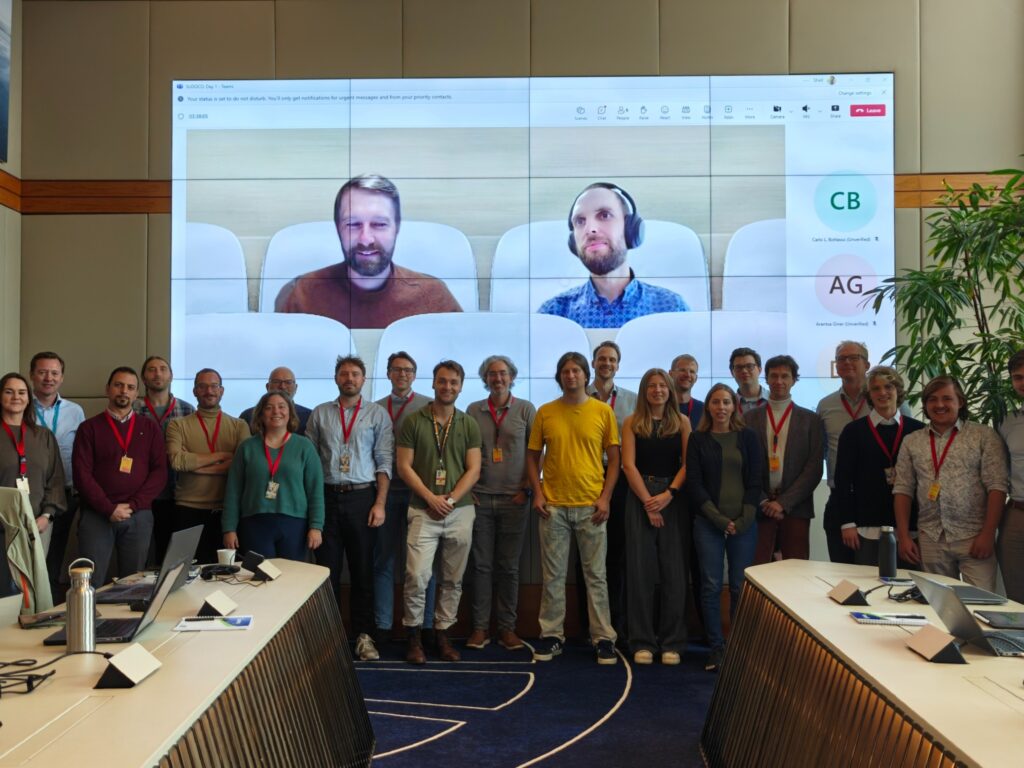
SUDOCO General Assembly in The Hague: Advancing the Control Room of the Future
On 8–9 October 2025, the SUDOCO consortium met in The Hague to review progress on the project, presenting key results on the Control Room of the Future and welcoming in person the new partner NTUA.
On 8–9 October 2025, the SUDOCO consortium gathered in The Hague, Netherlands, for its latest General Assembly. The meeting, kindly hosted by Shell in its historical first headquarter, was an important milestone in the project, confirming that activities are progressing according to plan and highlighting major advancements towards the Control Room of the Future — a central vision of SUDOCO to enable more efficient, resilient, and sustainable offshore wind farms.
A key focus of the meeting was the presentation of two major deliverables. The first, D4.1 – Control Room of the Future (Framework), introduces an integrated decision-making framework that combines models of wind farm aerodynamics, turbine health, economic performance, and environmental impact. It outlines two complementary control strategies — a lifetime-aware optimisation approach and a “desirability” method — enabling operators to balance economic, structural, and environmental objectives. The deliverable also incorporates advanced surrogate models for predicting turbine loads and structural health, which are crucial for optimising wind farm operation over its lifetime.
The second, D5.1 – Design-Friendly Control Strategies, tackles the complex challenge of co-designing wind farms and their control systems. It presents innovative approaches using machine learning, graph neural networks, and genetic algorithms to rapidly predict optimal control settings, such as yaw angles for wake steering, in milliseconds. It also explores the complementary role of emerging techniques like Helix control, investigates environmental and economic co-design objectives, and analyses the impact of control strategies on turbine loads and operational costs.
The General Assembly was also an opportunity to welcome NTUA (National Technical University of Athens) as a new partner in the consortium. Their expertise will further strengthen the project’s capabilities, particularly in modelling and simulation in the Mediterranean Sea conditions.
Discussions also focused on ongoing efforts to refine surrogate models — key tools to enhance the predictive power and efficiency of the Control Room of the Future. These models will play a central role in improving decision-making and operational strategies for next-generation offshore wind farms.
Looking ahead, the consortium is preparing for the next major project meeting in Milan (Italy), where wind tunnel testing at Politecnico di Milano will begin in February 2026. These experimental campaigns will provide valuable data to validate models and control strategies under realistic conditions, paving the way for future field applications.
Discover more about the project through our presentation video.