Towards the Control Room of the Future: SUDOCO releases the first three info-packs on smarter, lower-carbon offshore wind farms
Three short, open-access info-packs summarise new SUDOCO results on wind farm co-design, fatigue-load prediction and carbon accounting. All three are building blocks of the project’s Control Room of the Future.
Offshore wind is expected to supply a growing share of Europe’s electricity, but the way wind farms are designed and run still leaves value on the table. Turbines sitting in each other’s wake produce less energy and wear out faster. Decisions on layout, control and maintenance are also usually taken separately, with cost as the main yardstick.
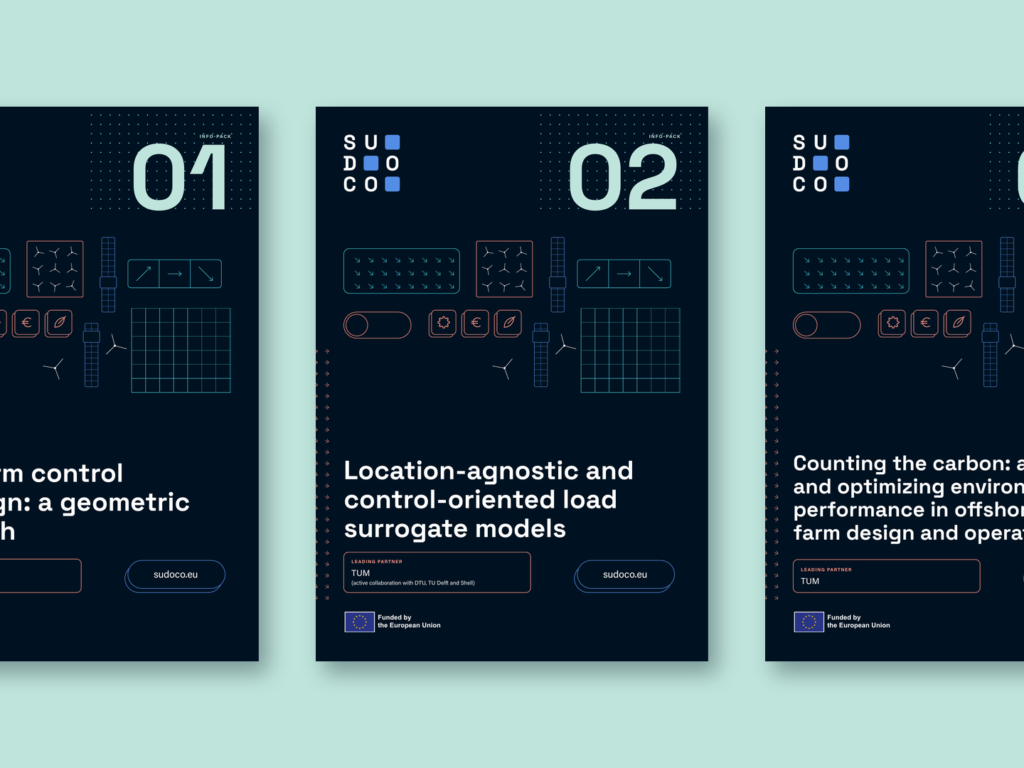
SUDOCO is a Horizon Europe project working towards a Control Room of the Future: a decision-support environment that weighs energy yield, turbine lifetime, cost and environmental impact together. Today the consortium releases three info-packs. Each one is a concise, accessible summary of peer-reviewed research, with key figures, the related Key Exploitable Results and a contact person.
Info-pack #1 – Wind farm control co-design: a geometric approach (author: Matteo Baricchio, TU Delft)
Wake steering means turning upstream turbines slightly out of the wind to deflect their wakes. It is normally optimised only after the layout is fixed. TU Delft researchers instead built it into the layout optimisation itself, using a tailored genetic algorithm and a fast geometric method to estimate yaw angles. For a 16-turbine farm at the Hollandse Kust Noord site, co-design raised annual energy production by 0.3–0.4%, and by up to about 0.6% for larger farms. A multi-objective version keeps gains above 0.3% while limiting losses to below 0.1% if wake steering is later not used.
Info-pack #2 – Location-agnostic and control-oriented load surrogate models (author: Adrien Guilloré, TUM; with DTU, TU Delft and Shell)
Estimating turbine fatigue loads usually requires computationally expensive simulations. SUDOCO’s machine-learning surrogates predict these loads almost instantly for any turbine in a farm, using local wind conditions and control settings. In independent farm-level validation, the error stayed below 4% for all load channels. The models cover the IEA 3.4 MW onshore and IEA 22 MW offshore reference turbines.
Info-pack #3 – Counting the carbon (author: Samuel Kainz, TUM)
For the project’s main case study, a scaled Hollandse Kust Noord farm with 69 turbines of 22 MW, the life-cycle carbon footprint is estimated at 11.2 kg CO₂eq/MWh. Steel is the largest source of these emissions, and vessel activities account for almost a third. The study also finds that economic and carbon optima are largely aligned. In a separate analysis, wake steering optimised for power increased the grid emissions displaced by around 3%.
All three info-packs are free to download from the SUDOCO community on Zenodo and via the project website.